The map shows current residence; it does not establish family origins. Province data covers only the published top thirty lists.
Start by entering a name.
Dark: rank one · Medium: top three · Pale: top thirty · Grey: below list threshold
The most honest answer we can give to "where is my surname from?" is this: where your surname is carried today, by how many people and how densely. This tool maps TÜİK's lists of the 30 most common surnames in each province for 2018–2025. Type your surname to see every province whose list it appears in, with its rank and number of bearers.
What data does the tool use?
TÜİK, Türkiye's statistics office, publishes the 30 most common surnames for each of the 81 provinces from the Address-Based Population Registration System (ADNKS), with counts. We have the lists for eight years, 2018 to 2025. In TÜİK ADNKS 2025 they contain 2,449 rows and 266 different surnames; across all eight years, 280 different surnames appear. The tool returns results for each of those 280.
ADNKS counts the population resident in Türkiye on 31 December of each year. The map therefore shows where bearers of a surname live now, not where their family is registered or where they were born.
How do I read the map?
Each province is shaded by how the selected surname stands there. Hovering shows three things: the surname's rank in the province list, its number of bearers and its concentration.
- Rank and count come straight from TÜİK. Example: in TÜİK ADNKS 2025, Yılmaz ranks 1st in İstanbul with 230,115 bearers and 11th in Iğdır with 1,412.
- The concentration index shows how common the surname is in a province compared with Türkiye as a whole: (count in the province ÷ province population) ÷ (national count ÷ national population). 1 is average, 2 is twice the average. Example: Polat scores 5.59 in Kilis (TÜİK ADNKS 2025). 2,797 people there carry the name, about five and a half times the national rate.
- The index can only be computed for surnames whose national total is known, that is the national top 30. For other surnames the map shows the rate per 1,000 residents (count ÷ province population × 1,000).
Large provinces always stand out because they are populous, so the shading follows concentration, not raw counts. The 230,115 Yılmaz in İstanbul are far more people than the 2,990 in Ardahan. Yet one person in 30 is a Yılmaz in Ardahan, against one in 68 in İstanbul.
What if my surname does not show in a province?
A surname missing from a province's list does not mean nobody carries it there. It only means its count is below that province's 30th entry. The tool shows such provinces in grey with an upper bound, such as "< 39,584".
In large provinces that bound is high. In TÜİK ADNKS 2025, the 30th entry in İstanbul is Güneş with 39,584 bearers. Aras is not on the İstanbul list, so fewer than 39,584 people in İstanbul are called Aras. That could be zero or 39,000. In Iğdır, where Aras ranks first, there are 2,795. So our data cannot tell whether there are more people called Aras in İstanbul or in Iğdır.
What does "number one in only one province" tell me?
In TÜİK ADNKS 2025, Yılmaz leads in 57 of the 81 provinces. Some surnames lead in a single province:
- Aras is first in Iğdır (2,795 people). It is 10th in Kars and 28th in Erzurum, and on no other province list.
- Çelik leads only in Muş, yet appears on 79 province lists.
- Yıldırım leads only in Elazığ and appears on 80 lists.
- Yıldız leads only in Siirt, Doğan only in Adıyaman and Kılıç only in Aksaray.
These examples make one thing clear: being first in a province does not make a surname "from" that province. Çelik is common almost everywhere; in Muş it is simply a little ahead of the others.
There are opposite cases too. In TÜİK ADNKS 2025, 131 surnames appear on one province list only. Ustabaş is only on the Artvin list (11th, 1,180 people) and Kopuz only on the Rize list (14th). They may well be carried in other provinces, but Artvin and Rize are the only places where they are numerous enough to reach the top 30.
Does the distribution change between 2018 and 2025?
Slowly. The year slider lets you follow a surname over eight years. Ustabaş moved from 14th in Artvin in 2018 to 11th in 2025. Siirt was led by Yılmaz in 2018 and by Yıldız since 2019. Between 2018 and 2025 the number-one surname changed at least once in 6 provinces. Counts move with births, deaths, migration and name changes, and because ADNKS counts people where they live, moves between provinces reshape the map too.
How do you read the province data for Polat?
In TÜİK ADNKS 2025, Polat ranks 19th nationally with 273,871 bearers. Search for it and you see it on 30 province lists. Its highest rank is in Kilis (2nd, 2,797 people), followed by Erzurum (3rd, 9,429) and Ağrı (6th, 6,183). The province with the most bearers is Gaziantep, where 26,210 people put it in 7th place.
Because the shading shows concentration, the map colours Kilis darkest: an index of 5.59. Gaziantep has more than nine times as many bearers as Kilis, but an index of 3.71. The year slider adds one more detail: Polat led Kilis in 2021 and 2022 and was second in the other years. What this reading tells you is that Polat is more common than average in these provinces today. What it does not tell you is that a family called Polat comes from any of them.
What are the limits of "where is it from"?
The map shows how common a surname is, not where it originated. There are three reasons:
- A surname is not a place record. Under the 1934 Surname Law, families chose their surnames at roughly the same time. A word such as Kaya, Demir or Yılmaz could be chosen independently by many unrelated families. Today Yılmaz, Kaya and Demir are on the list of every one of the 81 provinces.
- The map shows the present. ADNKS counts current addresses. Migration to the big cities and abroad changed the 1934 distribution long ago.
- Smaller surnames are not listed. Most of the 5,194 surnames on this site are in no province's top 30. No official province-level counts are published for them.
The distribution of a surname says nothing about the ancestry, ethnic background or faith of the people who carry it, and we draw no such conclusions.
What if my surname is not on any list?
If your surname is not among the 280, the tool says so plainly and does not produce an estimate. These steps help instead:
- Look at the surname's meaning and structure. If the root is a place name (Konyalı, Denizli), that is a fact about the word itself.
- Talk to older relatives. The 1934–1936 registrations and the family register at the civil registry office show where a family is registered.
- The e-Devlet service "Alt-Üst Soy Bilgisi" shows the registration places of your own family line, from your own record.
Which surname leads each province?
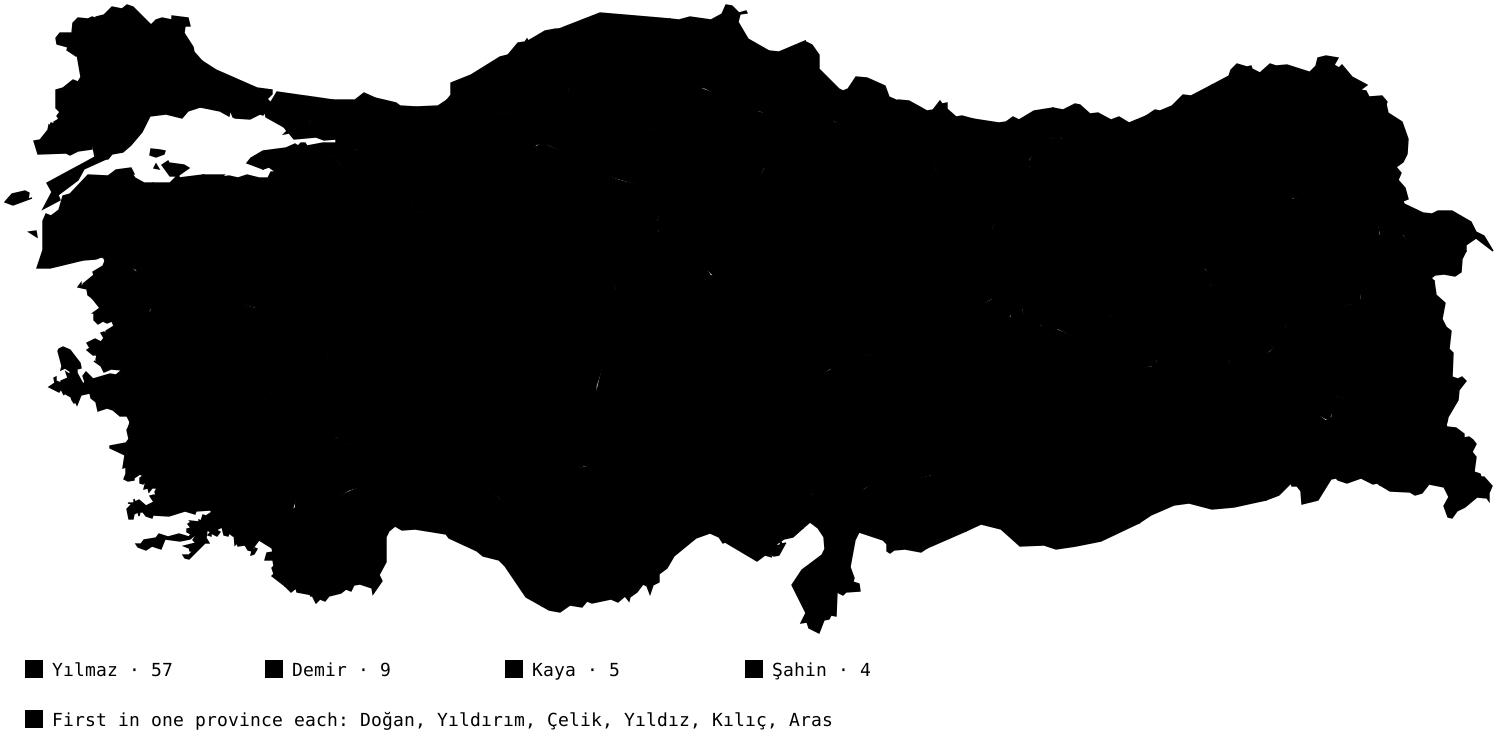
| Province | Surname | People | Population share (%) |
|---|---|---|---|
| Adana | Yılmaz | 26,146 | 1.14 |
| Adıyaman | Doğan | 8,594 | 1.39 |
| Afyonkarahisar | Yılmaz | 10,021 | 1.33 |
Source: TÜİK ADNKS. Calculations use the published lists.
Which surnames lead exactly one province?
| Surname | Province | Top thirty list count |
|---|---|---|
| Aras | Iğdır | 3 |
| Çelik | Muş | 79 |
| Doğan | Adıyaman | 66 |
| Kılıç | Aksaray | 69 |
| Yıldırım | Elazığ | 80 |
| Yıldız | Siirt | 80 |
Source: TÜİK ADNKS. Calculations use the published lists.
Which surnames lead the most provinces?
| Surname | Province count |
|---|---|
| Yılmaz | 57 |
| Demir | 9 |
| Kaya | 5 |
| Şahin | 4 |
| Aras | 1 |
| Çelik | 1 |
| Doğan | 1 |
| Kılıç | 1 |
| Yıldırım | 1 |
| Yıldız | 1 |
Source: TÜİK ADNKS. Calculations use the published lists.
What else do readers ask?
- How can I find out where my surname is common?
Type it into the tool. If it appears on TÜİK's top-30 lists for the 81 provinces (2018–2025), you see its rank, count and concentration in each province.
- Is the province where my surname is most common my family's home?
That cannot be concluded. The same surname was chosen independently by many families in 1934, and ADNKS counts current addresses. Your civil-registry record shows where your family is registered.
- My surname is not listed. Does that mean it is rare?
Only that it is not in any province's top 30. To make the Istanbul list in TÜİK ADNKS 2025, a surname needed at least 39,584 bearers.
Which sources were used?
- 1Türkiye İstatistik Kurumu (TÜİK) · TÜİK Nüfus İsim Portalı: En çok kullanılan soyisimler (ADNKS)
- 2Türkiye İstatistik Kurumu (TÜİK) · TÜİK ADNKS: Cinsiyete göre nüfus, Türkiye ve 81 il
- 3T.C. Resmî Gazete / Mevzuat Bilgi Sistemi (mevzuat.gov.tr) · Soyadı Kanunu (Kanun No. 2525)