When did Turkish last names come into being?
Turkish surnames in today’s sense date from 1934. The Surname Law, Law No. 2525, was passed on 21 June 1934, published in the Official Gazette on 2 July 1934 and came into force on 2 January 1935. Its first article is a single sentence: every Turk must carry a surname in addition to a given name. The second article fixed the order that now seems obvious: in speech, writing and signatures the given name comes first and the surname last.
Many families were known by a name before the law, but that name was not compulsory and was not fixed in one form in the population register. People were identified, in official papers and in daily life alike, by their given name, their father’s name, a nickname or a title. Some family names can be traced in the sources for centuries. The Karaosmanoğulları, a dynasty of provincial notables around Manisa, and the Çapanoğulları of Bozok are well-known examples. A family name recorded in older texts as Uşşakizade was taken as the surname Uşaklıgil by the novelist Halit Ziya after the law. -oğlu, -zade and -gil were three ways of saying “son of” or “household of”.
The details were set out in the Surname Regulation of 24 December 1934:
- New surnames were to be taken from the Turkish language (Art. 5).
- A surname could be used on its own or together with “(oğlu)” (Art. 6).
- Names of ranks and offices, tribe names, names of foreign nations and ridiculous names were banned (Arts. 7–10).
- If unrelated families in the same village, town or city chose the same name, it went to whoever applied first.
- The deadline was 2 July 1936. For anyone who had not chosen a surname by then, the governor or district governor chose one.
In the same period, Law No. 2590, passed on 26 November 1934, removed titles and honorifics such as ağa, bey, paşa, efendi and hanım from official use. Official identity was reduced to “given name + surname”. All the articles are covered in our Surname Law section, and the registration process step by step in how surnames were registered.
What is a Turkish last name made of?
Most Turkish surnames are one word or a compound of two. Every entry on this site places the surname in one of these formation classes:
- Simple noun: a single dictionary word. Kaya ‘rock’, Demir ‘iron’.
- Adjective: a word for a quality. Kara ‘black, dark’, Çetin ‘tough’, Uysal ‘gentle-natured’.
- Verbal: a verb form. Yılmaz is the negative of yılmak ‘to lose heart’: ‘one who does not lose heart’. Korkmaz ‘fearless’ follows the same pattern.
- Compound: two words. Öztürk = öz ‘genuine, pure’ + Türk; Aktaş = ak ‘white’ + taş ‘stone’.
- Suffixed: a root plus a derivational suffix. Demirci = demir ‘iron’ + the occupational suffix -ci: ‘blacksmith’.
- Patronymic: names built with -oğlu. Hasanoğlu ‘son of Hasan’, Demircioğlu ‘son of the blacksmith’.
- Toponymic: Konyalı ‘from Konya’, or Aras, the name of a river.
- 1934 pattern: compounds of favourite elements that are not dictionary words. Gürses = gür ‘full, strong’ + ses ‘voice’.
Some elements recur constantly. At the front: Öz-, Ak-, Kara-, Gök-, Er- and Ay-. At the end: -oğlu, -türk, -soy, -kan, -er, -can, -lı and -cı. Each has its own page: Öz-, Kara-, -oğlu, -türk, -lı/-li, -cı/-ci; the rest are in the affix index.
One rule helps when reading them: in Turkish compounds the weight of the meaning sits on the last element. Karakaya is a kind of rock, Özdemir a kind of iron. On this site the subject category of a surname follows that last element too. Roots, suffixes, vowel harmony and common mistakes in splitting names are covered in detail in how Turkish surnames are formed.
What are the most common Turkish last names?
According to TÜİK’s Address-Based Population Registration System (ADNKS) for 2025, the most common surname in Türkiye is Yılmaz, borne by 1,177,896 people. It is followed by Kaya (899,722) and Demir (876,934). The top ten:
- Yılmaz: 1,177,896
- Kaya: 899,722
- Demir: 876,934
- Çelik: 717,655
- Yıldız: 697,080
- Şahin: 688,214
- Yıldırım: 666,723
- Öztürk: 586,831
- Aydın: 581,387
- Özdemir: 556,378
The list is remarkably stable. The top 30 of 2018 and the top 30 of 2025 consist of the same surnames, and the first 22 places have not changed in eight years. Yılmaz stood at 1,134,443 in 2018. The only movement is at the bottom: Yavuz rose from 25th in 2018 to 23rd in 2025, while Çakır and Özcan each slipped one place.
TÜİK counts spelling variants separately. Arslan (521,149) and Aslan (409,459) are two forms of the same word, ‘lion’. Added together they come to 930,608, more than Kaya. When you look at how common a surname is, it is worth allowing for its variant spellings.
The full top 30, with counts, rank changes and short meanings, is in the table below. Year-by-year lists are on the most common surnames page.
How are surnames grouped by meaning?
The surnames on this site are arranged by meaning into main groups and the categories beneath them. How the 30 most common surnames spread across these groups shows how wide the vocabulary was that Turkish families chose from:
- Nature: Kaya and Aktaş (rock, stone), Yıldız and Güneş (sky), Yıldırım and Şimşek (weather), Aydın (light). See nature surnames.
- Metals: Demir, Çelik, Özdemir, Polat. See metal and object surnames.
- Animals: Şahin, Doğan, Arslan, Aslan, Kurt, Koç. See animal surnames.
- Character and virtue: Yılmaz, Çetin, Korkmaz, Yavuz, Acar, Can. See character surnames.
- Colours: Kara, Çakır. See colour and number surnames.
- War and heroism: Kılıç ‘sword’. See war and heroism surnames.
- Society and values: Öztürk. See society and kinship surnames.
- Name patterns: Özkan, Özcan, Erdoğan, built from old Turkic name elements. See lineage, place and name patterns.
Two groups that never appear in the top 30 matter as well. Occupational surnames carry the name of a trade: Demirci ‘blacksmith’, Terzi ‘tailor’, Çiftçi ‘farmer’, Yazıcı ‘scribe’. Title and nickname surnames preserve old titles and bynames: Tekin, Çelebi, Topal. Common misconceptions about title words are taken apart in Ottoman and “noble” surnames; the meanings of nature and virtue words are explained in beautiful and meaningful Turkish surnames. Each group contains narrower categories, such as celestial surnames or craft surnames; all are listed in the category index.
Which languages do the words come from?
The great majority of Turkish surnames are built from Turkish words. But Turkish vocabulary has drawn on other languages for centuries, and surnames reflect that mix. Even the top 30 contains examples. Şahin and Polat come from Persian; Can is Persian cān ‘soul, life’. Nişanyan Sözlük traces Acar to an Arabic adjective. In Özcan, Turkish öz stands next to Persian can.
Each language of origin has its own page on this site:
- Surnames from Turkic words: Kaya, Demir, Yıldız, Bengü.
- From Arabic words: Adil, Nur, Kadıoğlu.
- From Persian words: Şahin, Polat, Gül, Terzi.
- From Greek words: Fidan, Kiraz, Temel.
- From Mongolic words: Mergen, Noyan, Giray.
- From European languages: Onur, Berber, Fırtına.
- From other languages: for example Akşit, from a Sogdian title.
- Words of Armenian origin and words of Kurdish origin are covered on their own pages, as far as sources document them.
All of these pages follow one principle: the language a word comes from says nothing about the origin of the people who carry the surname today. Etymology is the history of the word, not of the family. All languages are listed in the origin index.
How do surnames vary across the provinces?
TÜİK also publishes the 30 most common surnames for each province. In the 2025 lists Yılmaz is first in 57 of the 81 provinces. Demir is first in 9, Kaya in 5 and Şahin in 4. Doğan (Adıyaman), Yıldırım (Elazığ), Çelik (Muş), Yıldız (Siirt), Kılıç (Aksaray) and Aras (Iğdır) each top one province.
Only three surnames make the top 30 in all 81 provinces: Yılmaz, Kaya and Demir. The 2025 provincial lists contain 266 different surnames, and 131 of them appear in a single province’s list only (TÜİK’s spellings Yalçın/Yalçin and Özbek/Ozbek are counted as one surname each). Many names that never reach the national list are prominent in one province:
- In Iğdır, Aras is first with 2,795 people, just ahead of Kaya with 2,776.
- In Rize, Yazıcı is second with 4,139.
- In Şanlıurfa, Çiftçi is second with 34,705.
- In Bayburt, only two people separate Yılmaz (855) and Bayram (853).
- In Kilis, Yılmaz has 2,843 bearers and Polat 2,797.
The largest numbers are naturally found in the most populous provinces: in İstanbul, 230,115 people are called Yılmaz. That is why, when comparing provinces, rank tells you more than the raw count. Each province’s top 30 and its changes since 2018 are on the surnames by province page; see for example Iğdır or Rize.
Does my surname show where my family comes from?
Not on its own. For most families, a surname is a word that the head of the household chose, or an official assigned, in 1935–1936. That a word is Persian or Arabic does not mean the family that chose it spoke that language; those words were already part of Turkish. The surname Demirci suggests that an ancestor may have been a blacksmith, but it does not prove it.
Province data is not origin data either. ADNKS is an address-based register: it counts where the bearers of a surname live today, not where the family came from. Two families with the same surname need not share any ancestry. The regulation reserved a name for the first applicant only within the same village, town or city; elsewhere, other families could choose the same name.
On this site we describe the origin of surnames in linguistic terms only. We draw no conclusions about anyone’s ancestry, ethnicity or faith from a surname. For family history the surname is a good starting point; the real evidence is in population registers and family documents.
How do you read a surname page?
Every surname page follows the same order, so that two names are easy to compare:
- Pronunciation: syllables, audio and stress.
- Meaning: the dictionary meaning. The short meaning in the header summarises it.
- Root tree: the words that make up the surname, their languages and the source for each.
- Formation & 1934: the formation class and the relevant 1934 rule.
- Name family and spellings: surnames that share a root, and variant spellings (such as Arslan and Aslan).
- How many: counts, rank history and a province map, only for surnames that appear in TÜİK’s lists. We show no count for a surname that is not in them.
- Sources: the dictionary, law or dataset behind each statement.
Note the certainty remark in the meaning section. An established etymology is one the dictionaries give plainly. “Probable” means the analysis is transparent but no source discusses that particular surname. “Disputed” means the sources disagree; each view is then given with its source. For a quick look at meanings you can also use the list of surnames and their meanings; how the data was compiled is explained on the methodology page.
Where should I go next?
This guide is the map. For more detail:
- Structure: how Turkish surnames are formed.
- Titles and history: Ottoman and “noble” surnames: fact and legend.
- Themes of meaning: beautiful and meaningful Turkish surnames.
- Beyond the lists: unusual Turkish surnames.
- Law: the 1934 Surname Law, banned surnames and changing a surname today.
- Length: lists by number of letters, such as three-letter surnames.
Which surnames lead the 2025 ranking?
| Rank | Surname | People | Per thousand | One in how many? |
|---|---|---|---|---|
| 1 | Yılmaz | 1,177,896 | 13.68 | 73 |
| 2 | Kaya | 899,722 | 10.45 | 96 |
| 3 | Demir | 876,934 | 10.19 | 98 |
| 4 | Çelik | 717,655 | 8.34 | 120 |
| 5 | Yıldız | 697,080 | 8.1 | 124 |
| 6 | Şahin | 688,214 | 7.99 | 125 |
| 7 | Yıldırım | 666,723 | 7.74 | 129 |
| 8 | Öztürk | 586,831 | 6.82 | 147 |
| 9 | Aydın | 581,387 | 6.75 | 148 |
| 10 | Özdemir | 556,378 | 6.46 | 155 |
| 11 | Arslan | 521,149 | 6.05 | 165 |
| 12 | Doğan | 485,906 | 5.64 | 177 |
| 13 | Kılıç | 450,572 | 5.23 | 191 |
| 14 | Aslan | 409,459 | 4.76 | 210 |
| 15 | Çetin | 345,329 | 4.01 | 249 |
| 16 | Kara | 290,024 | 3.37 | 297 |
| 17 | Kurt | 289,723 | 3.37 | 297 |
| 18 | Koç | 286,207 | 3.32 | 301 |
| 19 | Polat | 273,871 | 3.18 | 314 |
| 20 | Şimşek | 253,543 | 2.95 | 340 |
| 21 | Korkmaz | 250,142 | 2.91 | 344 |
| 22 | Özkan | 245,254 | 2.85 | 351 |
| 23 | Yavuz | 236,317 | 2.74 | 364 |
| 24 | Çakır | 235,286 | 2.73 | 366 |
| 25 | Özcan | 233,820 | 2.72 | 368 |
| 26 | Erdoğan | 233,535 | 2.71 | 369 |
| 27 | Can | 230,085 | 2.67 | 374 |
| 28 | Acar | 228,386 | 2.65 | 377 |
| 29 | Güneş | 227,203 | 2.64 | 379 |
| 30 | Aktaş | 222,711 | 2.59 | 387 |
Source: TÜİK ADNKS. Calculations use the published lists.
Which meaning groups contain surnames?
- Mountains, rocks and stones 252 surnames
- Water, sea and rivers 202 surnames
- Plains, highlands and countryside 60 surnames
- Trees and forest 114 surnames
- Flowers and plants 136 surnames
- Wind, rain and lightning 68 surnames
- Sky, sun, moon and stars 226 surnames
- Light and fire 119 surnames
- Time and seasons 72 surnames
- Metals and gemstones 259 surnames
- Tools and objects 123 surnames
- Birds of prey 73 surnames
- Other birds 44 surnames
- Lions, wolves and predators 70 surnames
- Domestic and other animals 127 surnames
- Colours 405 surnames
- Numbers and quantity 72 surnames
- Courage and resilience 221 surnames
- Virtue and integrity 336 surnames
- Intellect and wisdom 166 surnames
- Heart, joy and hope 319 surnames
- Fortune, blessing and fame 217 surnames
- Appearance, body and strength 343 surnames
- Kinship and family 165 surnames
- Homeland, nation and ideals 164 surnames
- Words from religious vocabulary 136 surnames
- Old Turkic titles 131 surnames
- Ottoman titles 73 surnames
- Surnames from nicknames 300 surnames
- Heroes and warriors 194 surnames
- Weapons and arms 152 surnames
- Military ranks and roles 96 surnames
- Crafts: metal, wood, stone and leather 175 surnames
- Textile and clothing trades 87 surnames
- Farming, herding and hunting 166 surnames
- Food, market and trade 180 surnames
- Services, roads and seafaring 107 surnames
- Scribes, scholars and healers 68 surnames
- Bards, poetry and music 54 surnames
- Patronymic -oğlu surnames 673 surnames
- Place-based -lı/-li surnames 145 surnames
- Names of mountains, rivers and places 365 surnames
- Oghuz and historical Turkic tribe names 59 surnames
- Built from Turkic name elements 413 surnames
- Compounds coined in 1934 170 surnames
- Lineage, blood and origin words 126 surnames
- Historical and legendary names 155 surnames
Which surname leads each province?
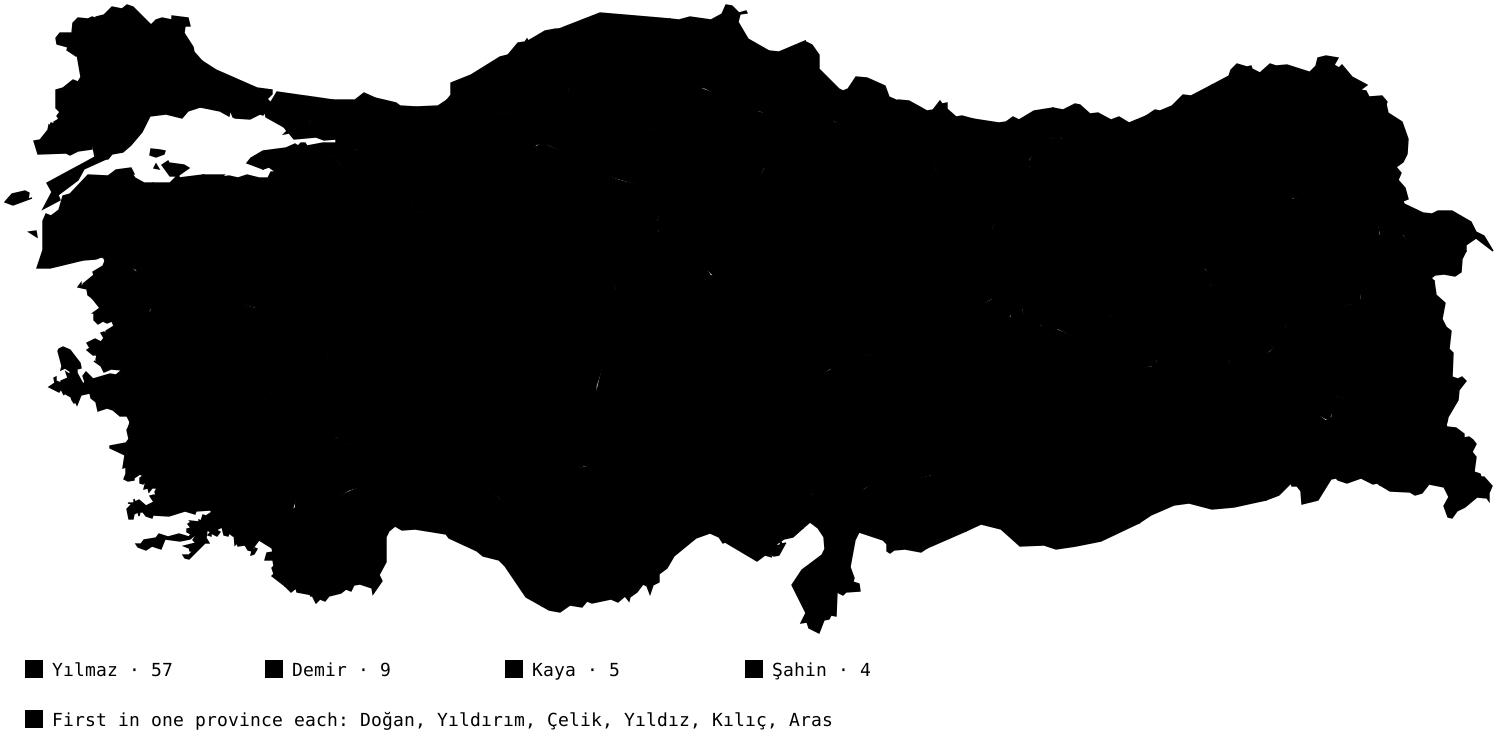
| Province | Surname | People | Population share (%) |
|---|---|---|---|
| Adana | Yılmaz | 26,146 | 1.14 |
| Adıyaman | Doğan | 8,594 | 1.39 |
| Afyonkarahisar | Yılmaz | 10,021 | 1.33 |
Source: TÜİK ADNKS. Calculations use the published lists.
What else do readers ask?
- What is the most common surname in Türkiye?
According to TÜİK ADNKS 2025, Yılmaz is the most common surname in Türkiye with 1,177,896 bearers, followed by Kaya (899,722) and Demir (876,934).
- Since when have Turks had surnames?
The Surname Law (No. 2525) was passed on 21 June 1934 and came into force on 2 January 1935. The deadline for registering surnames was 2 July 1936.
- What does the surname Yılmaz mean?
Yılmaz is the negative form of the verb yılmak ‘to lose heart and back away’, so it means ‘one who never gives up’. More on the Yılmaz page.
- Does the language of a surname show a family’s origin?
No. The origin of the word is the history of the word. Words of Arabic or Persian origin were already part of Turkish in 1934, and families chose their surnames from that shared vocabulary.
Which sources were used?
- 1Türkiye İstatistik Kurumu (TÜİK) · TÜİK Nüfus İsim Portalı: En çok kullanılan soyisimler (ADNKS)
- 2T.C. Resmî Gazete / Mevzuat Bilgi Sistemi (mevzuat.gov.tr) · Soyadı Kanunu (Kanun No. 2525)
- 3T.C. Resmî Gazete / Mevzuat Bilgi Sistemi (mevzuat.gov.tr) · Soyadı Nizamnamesi (Bakanlar Kurulu Kararı 2/1759)
- 4T.C. Resmî Gazete / Mevzuat Bilgi Sistemi (mevzuat.gov.tr) · Efendi, Bey, Paşa gibi Lakap ve Unvanların Kaldırılmasına Dair Kanun (Kanun No. 2590)
- 5Sevan Nişanyan · Nişanyan Sözlük: Çağdaş Türkçenin Etimolojisi
- 6Sevan Nişanyan · Nişanyan Adlar: Türkiye Kişi Adları Sözlüğü
- 7Türk Dil Kurumu · TDK Güncel Türkçe Sözlük
- 8Wikimedia · Vikipedi: Karaosmanoğulları
- 9Wikimedia · Vikipedi: Çapanoğlu Oymağı
- 10makale.isam.org.tr · makale.isam.org.tr: download